Overstock Sale on Traditional Chinese Medicine Books! Special pricing available while supplies last.
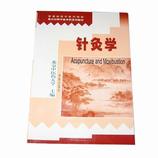
If you want to learn acupuncture and moxibustion, the ancient arts of Chinese healing here is the best resource for you. Acupuncture and Moxibustion is one of a set of seven that are published by China Academy Press as English-Chinese Colleagiate Textbooks in traditional Chinese medicine for institutions of TCM of higher Learning edited by Beijing University of Traditional Chinese Medicine.
Ever since its publication in 1999, it is a favorite reading material for non Chinese readers who are not familiar with Chinese concept of the universe, the human body, health, disease, prevention and treatment.
Do not be daunted by the fact that this set of books is designed for college use. You do not need college levels of training in physics, chemistry, math, calculus, etc which are the prerequisite courses to take before a college degree to medicine (conventional medicine, that is.) to understand. You do not have to learn Chinese language to read them because they are in both languages. If you want to learn Chinese, it is a perfect tool for you too.
Is the language “Chinglish” (meaning hard coined English few can understand)? Largely, “No!” No, because a few English speakers are among the few editors whose painstaking work with their excellent knowledge of both Chinese language and Chinese culture made the books highly readable and understandable. The implied “yes” to the answer, lies in the fact that on the one hand, the two textbooks are written and edited by well-versed Chinese TCM experts including well known doctors, researchers, professors from research and teaching institutions in China, and as authentic writing for teaching, they have to be very faithful to the basic TCM tenets, including the Chinese culture-bound concepts and logics, and on the other hand, they need to be understood by English speaking readers who may not be familiar with Chinese culture. It is always a formidable task to build a flexible and no nonsense bridge between the East and the West outlooks and concepts, theories and logics. This gigantic and overwhelming mission, improved by the English editors made the book enormously interesting and fantastically rewarding for the readers.
Here is the Table of Content for the volume:
Introduction
Part I: Meridians and Points
Chapter 1 A General Introduction to the Meridians
- Section 1 Development of the Theory of Meridians
- Section 2 The composition of the Meridian system
- Section 3 The Gen, Jie, Biao, Ben, Qijie and the Four Seas of the Meridians
- Section 4 Physiological Functions of the Meridians System and Clinical application of the Theory of the Meridian
- Section 5 The Courses of the Twelve Regular Meridians and their principal Symptoms
- Section 6 The Course, principal Symptoms and Crossing Acupoints of the Eight Extra Meridians
- Section 7 Acupoints, Courses, Principal Indications and Treatment of Fifteen Collaterals
Chapter 2 An Introduction to Acupoints
- Section 1 The Essential Concept of Acupoints
- Section 2 The Development and Classification of Acupoints
- Section 3 The Nomenclature of Acupoints
- Section 4 Properties of Acupoints
- Section 5 The Concept and Classification of Specific Points
- Section 6 Methods of Locating Acupoints
Chapter 3 The fourteen Meridians’ Acupuncture Points and the Extraordinary points
- Section 1 The Acupuncture Points of Lung Meridian
- Section 2 The Acupuncture Points of Large Intestine Meridian
- Section 3 The Acupuncture Points of Stomach Meridian
- Section 4 The Acupuncture Points of Spleen Meridian
- Section 5 The Acupuncture Points of Heart Meridian
- Section 6 The Acupuncture Points of Small Intestine Meridian
- Section 7 The Acupuncture Points of Bladder Meridian
- Section 8 The Acupuncture Points of Kidney Meridian
- Section 9 The Acupuncture Points of Pericardium Meridian
- Section 10 The Acupuncture Points of Triple Energizer Meridian
- Section 11 The Acupuncture Points of Gallbladder Meridian
- Section 12 The Acupuncture Points of Liver Meridian
- Section 13 The Acupuncture Points of Governor Vessel
- Section 14 The Acupuncture Points of Conception Vessel
Chapter4ExraordinaryPoints
- Section 1 Region of the Head and Neck
- Section 2 Points in the Region of the Chest and Abdomen
- Section 3 Points in the Region of the Back and Lumbar
- Section 4 points in the Region of the Upper and Lower Extremities
Part II Acupuncture and Moxibustion Techniques
Chapter 1 Filiform Needle
- Section 1 The Structure and Specification
- Section 2 Needle Practice
- Section 3 Preparations Prior to Acupuncture Treatment
- Section 4 Manipulation
- Section 5 management of Possible Accidents
- Section 6 Precautions in Acupuncture Treatment
Chapter 2 moxibustion
- Section 1 Classification of Moxibustion
- Section 2 moxibustion with Other Materials
- Section 3 Precautions
- Section 4 Contraindications of moxibustion
- Section 5 management After Moxibustion
Chapter 3 Other Acupuncture Therapies
- Section 1 The Three-Edged Needle
- Section 2 The Cutaneous Needle
- Section 3 The Intradermal Needle
- Section 4 Electro-Acupuncture
- Section 5 Hydro-Acupuncture
Chapter 4 Nine Needles in the Ancient Times and the Methods Listed in Internal Classic
Chapter 5 Scalp Acupuncture
Chapter 6 Ear Acupuncture
Part III Acupuncture and Moxibustion Treatment
Chapter 1 introduction
Chapter 2 Acupuncture Therapy
- Section 1 Internal diseases
- Section 2 Gynecological and Pediatric Diseases
- Section 3 External Diseases
- Section 4 Diseases and Syndromes of the Eye, Ear, Nose, Throat and Mouth













 Product Detail